Reviews
Part of Desk noise test: five stages, from vocabulary to a repeatable record
Does measuring your desk noise actually settle anything, or just waste an evening?
Is measuring your desk noise worth the trouble?: measurement helps in a few specific situations and wastes an evening in all the rest. How to tell which one you.
Measurement is a tool, not a virtue. It earns its place when it changes a decision. This is how to work out in advance whether yours will. If the reading will not change what you buy, skip the gear and put the money toward quiet keyboard costs instead.
What to take away
- Measure when there is a dispute, a repeated change to evaluate, or a pattern nobody can describe.
- Do not measure to prove a complaint wrong. It rarely works and it costs goodwill.
- Office desks sit far below the levels that occupational limits address, so those numbers will not help you.
- The cheapest useful test is a comparison between two states of your own room.
When it is worth it
When measuring is worth it
- Someone disputes it; dated record settles it
- About to spend money; want before reading
- Complaint is about certain times of day
- Testing several changes; need to tell apart
Measure when the gap is small. It covers two keyboards a few decibels apart, or a mat swap you cannot judge by memory. Measure when a complaint repeats and you cannot say what changed. Measure when a lease or a shared room needs a record.
When it is not
When measuring wastes an evening
- Everyone agrees noise exists; change something
- Want a number to argue with
- The change costs nothing; just make it
- Cannot control conditions; readings not comparable
Do not measure when the sound has an obvious, free fix: a rattling stabilizer, a hollow desk, a chair on a hard floor, a phone buzzing on the same surface.
Do not compare your desk with a colleague's in another room, because that measures the rooms.
Why occupational numbers will not settle a desk argument
Hearing-damage thresholds sit far above anything a desk produces. NIOSH sets a recommended exposure limit of 85 A-weighted decibels averaged over an eight-hour workday and says each 3 dBA increase above it should halve the allowable daily duration.
Its practical field test: sound at about 85 dBA usually forces you to raise your voice to be heard three feet away, and 95 dBA means shouting.
An office with a mechanical keyboard is nowhere near that. Distraction and annoyance are real problems, and they are not the problems those numbers were written for. Those written numbers rarely cover keyboard noise, so check what your lease says about silent keyboard switches before you buy anything.
For scale, a mechanical keyboard at a desk typically reads 45 to 65 A-weighted decibels at arm's length. Clicky switches sit at the top of that range. All of it is far below the NIOSH limit.
The five step comparison at home
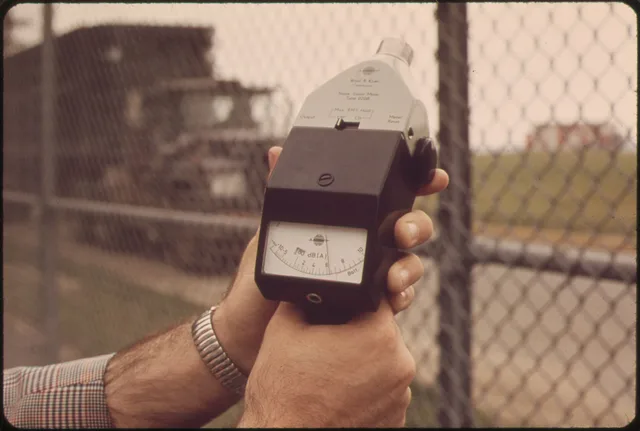
- Pick one app. A phone app that reports A-weighted decibels and offers a slow response setting is enough. The NIOSH Sound Level Meter is a free iOS example; hardware should carry an IEC 61672 Class 2 rating.
- Fix the phone. Stand it at ear height where the listener sits, and mark the spot so it cannot move.
- Stay in one room. Keep doors, windows and fans in the same state for every run.
- Compare before and after. Type the same paragraph at the same speed for 30 seconds. Change one thing, then repeat.
- Repeat each state twice. Variation between runs of one state sets the smallest difference you can trust.
Accuracy you can actually reach at home
You do not need laboratory precision, but research on getting closer is clear about where the limit sits. One experiment tested whether iOS phones and similar devices could be reliable instruments for noise exposure.
It compared three different types of microphone on the same devices against reference equipment. Its motivation was the very large number of workers who face potentially hazardous noise exposure.
The lesson for a desk is proportion. Your phone plus a fixed position plus repetition gets you far enough for a household decision, and the last few decibels of accuracy cost more than the decision is worth.
The result is a sentence, not a number. Either the level holds before and after, or it drops by a few decibels and the listener agrees the sound changed.
Deciding in two minutes
Write the decision you are about to make. The instrument questions, if you decide to go ahead, are in questions to ask before buying a sound meter, and the full method is in what happens at each stage.