Reviews
Part of Real published field research beats an invented workspace case study
Why do published workspace studies rarely name a single product?
Why published studies rarely name products, and what to do: research on workspaces reports categories rather than brands. The reasons are good ones.
Read enough workspace research and you notice something: almost nobody names the product. Studies say sit-stand workstation, damped keyboard, acoustic screen. They rarely say which one. That is deliberate, and knowing why makes studies and product reviews easier to read.
What to take away
- Studies report categories because the finding is about the category, not the item.
- The measured effects are small and personal, so a brand-level result would not generalize.
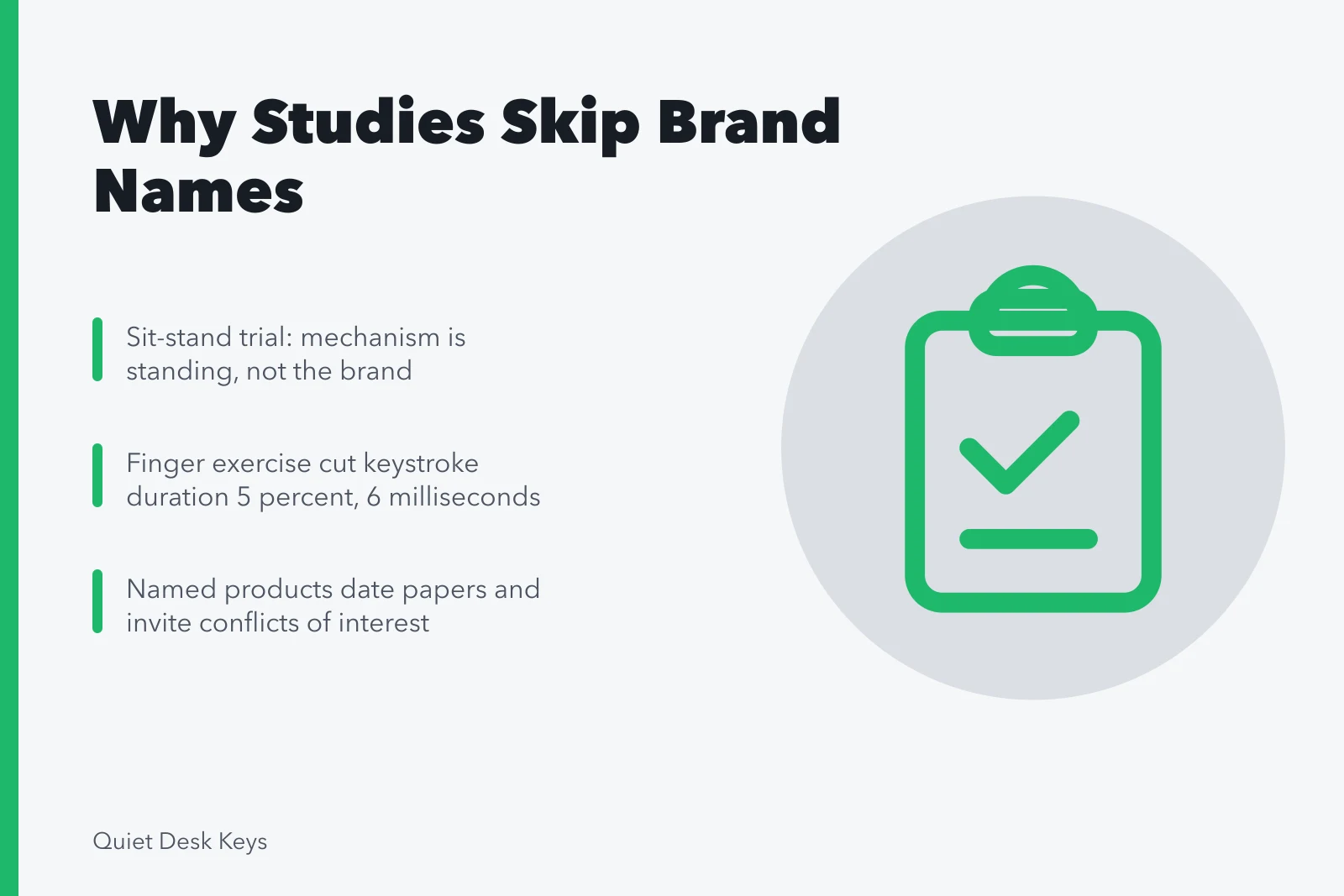
- Naming products would date a paper within a year and invite conflicts of interest.
- This is why a review and a study answer different questions, and why you need both.
Reason one: the effect belongs to the category
When a trial finds that a sit-stand workstation reduces sitting time, the mechanism is standing, not the brand. A multiphase feasibility study of workplace sit-stand desks in two companies in Cambridge, England, examined energy expenditure, sitting time and cardio-metabolic outcomes.
Sit-stand desk study stages
- Stage 1Online survey
- Stage 2Workspace audit
- Stage 3Three-month randomised desk provision
- Stage 4Qualitative component
It ran through an online survey, a workspace audit, a three month randomised provision of desks and a qualitative component. The desk is the intervention.
Which desk is a procurement detail, and reporting it would imply a specificity the design cannot support.
The gap between study control and buyer reality explains why a desk noise test has five stages worth understanding.
Reason two: the person is a bigger variable than the product
Measured differences between people usually exceed those between similar products.
Finger exercise shifts typing
5% shorter keystroke duration
About 6 milliseconds
Fourteen touch-typists
After submaximal isometric finger exercises
A lab typing experiment shows the scale: fourteen touch-typists performed submaximal isometric finger exercises. Then keystroke duration for the exercised finger decreased by 5 percent, about 6 milliseconds, immediately afterwards. If fifteen minutes of finger exercise moves typing behavior measurably, the same person on two similar keyboards is a noisier comparison than most product claims admit.
Reason three: dating and disclosure
A paper naming products stops being useful when the products are discontinued, which for input devices is a few years. A study published today and read in five years would send people looking for something that no longer exists.
The finding it reported would be quietly attached to whatever the manufacturer sells under that name instead. Journals also require conflict of interest declarations, and naming brands invites exactly the entanglement those declarations exist to surface. A researcher who names a winner acquires a commercial relationship whether or not they wanted one.
What this means for your reading
Good for
- Published study
- Whether a category of change helps at all
- Product review
- Build, service, packaging, delivery
- Your own trial
- Whether it works for you, in your room
Not good for
- Published study
- Which item to buy
- Product review
- Whether the category helps
- Your own trial
- Anything general
Use all three, in that order. Most people use only the middle row.
The practical method
Decide the category from the research, then shortlist within it using reviews and specifications, then test the shortlist in your own room. Each step narrows the question and uses the source competent to answer it.
Skipping the first step produces a shortlist of items that were never going to help, however good the individual products are. The buying questions that sit between the second and third steps are in questions to ask before buying, and the case for reading real research at all is made in published field studies worth reading.