Industry
Real published field research beats an invented workspace case study
No case studies are invented here. Real published field research on quiet workspaces exists, and it is more useful than any story a website could make up.
No case studies are presented on this page. Nobody has been visited, no office has been surveyed for this site, and writing five plausible stories would be fabrication dressed as evidence. What does exist is published field research on real workplaces and real homes, and it is more useful than an invented narrative because the method is written down.
What to take away
- Field studies exist for exactly the questions people ask, and most are free to read.
- A study's value is in its method section, which is the part a case study never has.
- Look for studies that measured a space before and after a change.
- Expect findings to be specific to their setting. That limit is a feature, not a flaw.
What a real study gives you that a case study does not
What a real study gives you
Published study
- Method
- Stated, and criticised by reviewers
- Sample
- Counted
- Failure
- Reported
- Conflict of interest
- Declared
- Comparison group
- Often present
Marketing case study
- Method
- Absent
- Sample
- One, chosen because it worked
- Failure
- Never mentioned
- Conflict of interest
- Usually the whole point
- Comparison group
- Never
A home soundscape study worth reading
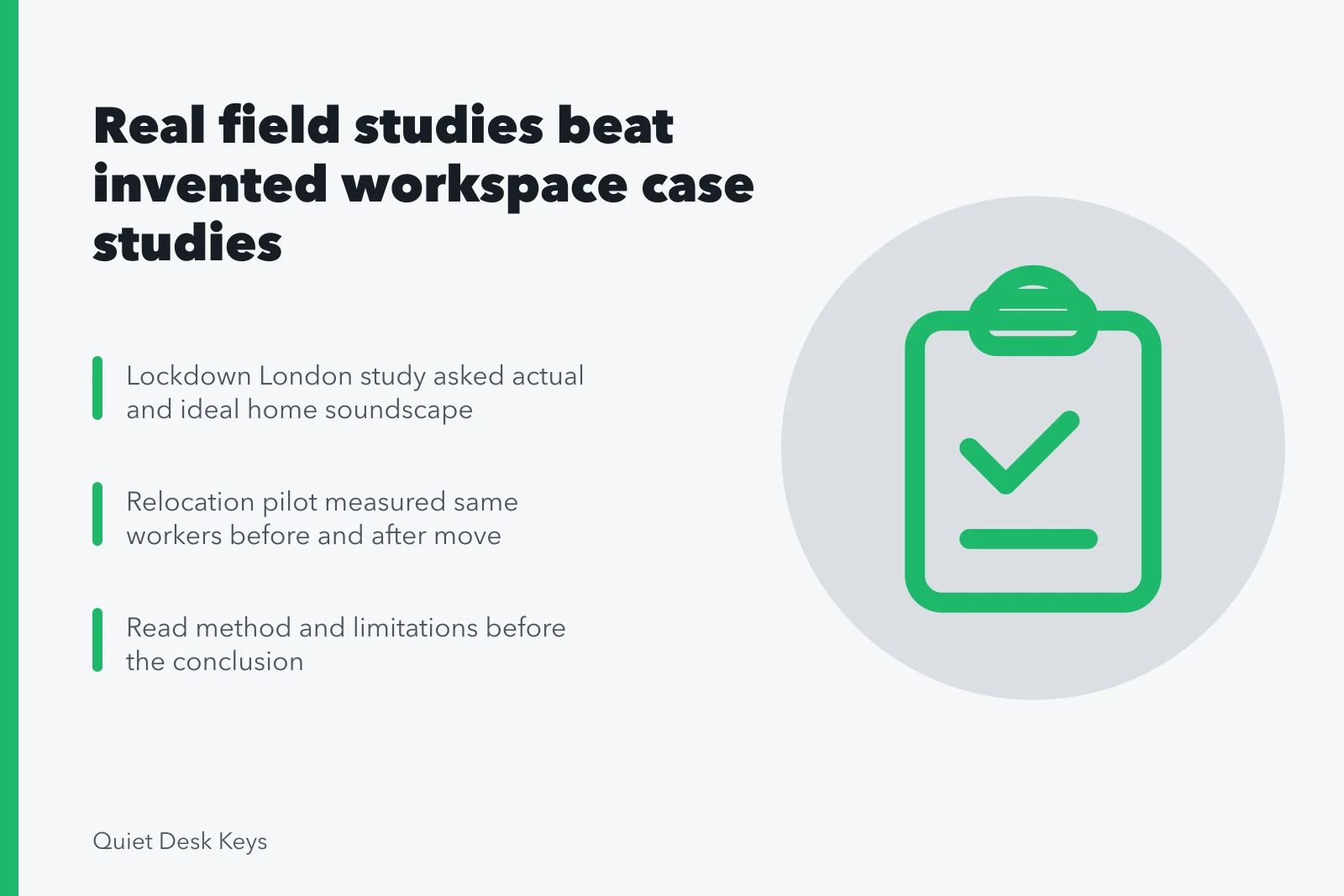
The closest published work to a home desk problem comes from the period when most office work moved into flats. A qualitative study during lockdown in London examined the actual and ideal indoor soundscape for working from home, relaxation and other activities, asking what people found annoying and what an ideal sound environment would contain.
The framing is the useful part. Most noise research measures what people want removed. This one asked what they wanted present, a question anyone rearranging a home office should ask themselves.
An office move measured before and after
The other kind worth reading is a relocation study, because it measures the same people in two environments. A pilot study followed office workers moving from a conventional office into an active, biophilic designed workplace and measured changes in workplace sitting time and self-reported habit strength around uninterrupted sitting and physical activity at work.
The design is the thing to copy at household scale: same people, two states, measured with the same instrument, and a stated expectation of what should change.
How to find them
- Search a public medical or building research index rather than a general search engine.
- Use the vocabulary the field usessoundscape, open-plan, occupant satisfaction, post-occupancy evaluation.
- Read the method and the limitations before the conclusion.
- Prefer studies that report a comparison, not a single site described favorably.
- Follow the references backwards. The paper that everyone cites is usually the one worth reading.
Most of this material is freely readable, because much of it was publicly funded and is deposited in open repositories as a condition of that funding.
How to find real studies
- Search a medical or building research index
- Use field vocabularysoundscape, post-occupancy evaluation
- Read method and limitations before conclusion
- Prefer studies reporting a comparison
- Follow references backwards to the cited paper
What to do with what you find
Take the method, not the conclusion. A study run in a different climate, building and culture will not give you your answer, and its measurement approach will transfer perfectly. The categories of change worth measuring are set out in what each type actually does, and the list of specific options is in ideas sorted by what they fix.