Guides
Part of Real published field research beats an invented workspace case study
Quiet workspace case studies: how to check whether one applies to your desk in 2027
Seven questions that decide whether a published finding is relevant to your room, plus what to do when the honest answer is that nothing quite fits.
This is a filter, not a reading list. Run a study through these seven questions and you will know in a few minutes whether it tells you anything about your desk.
What to take away
- Setting, sample and outcome are the three things that decide relevance.
- A published table of typical levels is a general framework, not a specification for your room.
- If nothing fits, that is a normal result.
- Write down what you borrowed and from where, so that next year you can check it again.
The seven questions
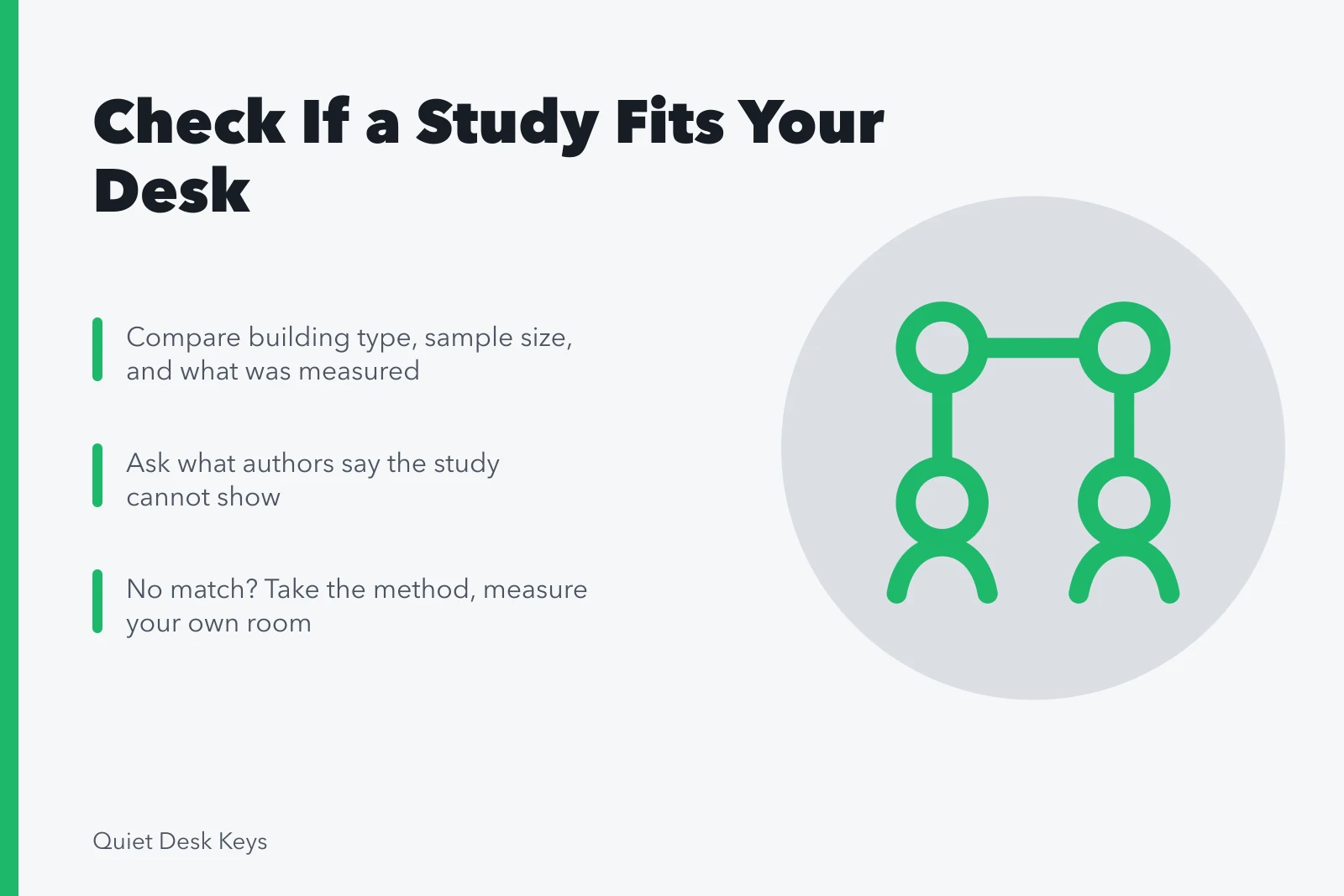
- What kind of building was it, and is mine similar?
- How many people, and were they doing work like mine?
- What exactly was measured, and is that the thing bothering me?
- Was there a comparison, or only one site described?
- How long did it run? Novelty effects last weeks.
- Who funded it, and does anyone in it sell the thing being studied?
- What do the authors themselves say the study cannot show?
Question seven is the fastest of the seven and the most often skipped.
Seven questions to test a study
- Building type similar to mine?
- People doing work like mine?
- Measured thing is my problem?
- Comparison or only one site?
- Long enough to outlast novelty?
- Funded by anyone selling it?
- What authors say it cannot show?
Treat published level tables as approximate
Charts of typical sound levels are useful for orientation and misleading as specifications. HyperPhysics generalizes the point in a different domain, and it applies to office-level charts.
Orientation versus specification
Level table
- Purpose
- General orientation
- Precision
- No precise standard
- Use for
- Rough framework
Your room
- Purpose
- Actual measurement
- Precision
- Specific to your space
- Use for
- Decisions about your desk
Its page of examples of sound level measurements gives a table of values tied to musical dynamic markings. It states plainly that there is no precise standard for what those markings mean, and the table is a general framework.
The same caution applies to every chart of typical office or household levels you will find. They orient you. They do not describe your room.
What good evidence looks like when it exists
Where the research is stronger, it usually combines measurement with what occupants actually report. One case study, in an existing office in Alexandria, Egypt, approached well-being as a route to productivity in an existing building rather than a new one. It found a link between occupant well-being and productivity in that building.
A second named example is the COPE project in Canada, a multi-building field study of open-plan offices. It found that noise and speech privacy were among the strongest sources of occupant dissatisfaction.
That is the situation almost everyone is in: the building already exists and cannot be redesigned. Studies set in existing spaces transfer better to a desk than studies of purpose-built ones, and they are worth seeking out for that reason alone.
Worked example: the Alexandria study
Take the Alexandria study above. Building: an existing office, not a new build. People: office occupants. Measured: well-being and productivity. Comparison: one site described. Duration: check the paper. Funding: public repository. Authors say: see the limitations. Verdict: borrow the method, not the result.
When nothing fits
This happens often and is not a failure. Home desks are under-studied compared with offices.
The honest response: take the measurement method from the nearest study and apply it to your own room. Your own before and after is better evidence about your desk than any paper.
It is also the only evidence still true next year, since your room will change and the paper will not.
How to measure your own room
You need a sound level meter or a calibrated phone app, a notebook, and two weeks. Measure at your desk, at ear height, during the hours you actually work. Record a baseline for five working days before you change anything.
Change one thing only, such as a screen or a rug. Measure for five more working days after. Compare the same hours and tasks. A difference of a few decibels is normal variation. Look for a consistent shift across days. Keep the notes with your source list.
Record what you borrowed
One line per source: the finding, the source, and what you did about it. Example: 'COPE project: noise and speech privacy; added a screen; recheck next year.' That takes seconds. In a year, it tells you whether you followed a good idea or a fashionable one.
The errors this filter is built to catch are in mistakes people make when borrowing from a study. Named field studies worth reading include the Alexandria study above and the COPE project in Canada. For finding studies at all, start with published field studies worth reading.