Guides
Desk noise test: five stages, from vocabulary to a repeatable record
A desk noise test has five stages: vocabulary, question, instrument, conditions, and record. This guide explains what each stage does and why the record matters.
Measuring desk noise is easy to do badly. A phone app produces a number in two seconds, and that number is almost meaningless without the four stages around it. This is what a usable test looks like from start to finish.
What to take away
- Decide what question the number answers before you take any reading.
- The microphone belongs where the listener is, not where the keyboard is.
- Comparisons are only valid within one testsame phone, same place, same conditions.
- A number without a stated method is not a measurement, it is an anecdote with a decimal point.
Stage one: the vocabulary
Two properties describe any sound, and mixing them up is the most common error. The National Park Service, which runs an acoustic monitoring program, sets them out plainly in its explanation of how sound is described and measured.
Frequency vs amplitude
Frequency
- What it is
- cycles per second
- Unit
- hertz
- Human range
- 20-20,000 Hz
- Everyday example
- pitch of sound
- Scale behavior
- linear
Amplitude
- What it is
- wave strength
- Unit
- decibels
- Human range
- 0 dB threshold
- Everyday example
- speech under 60 dB
- Scale behavior
- logarithmic
Frequency is pressure wave cycles per second in hertz; human hearing spans 20 to 20,000 hertz.
Amplitude is wave strength in decibels; lower hearing threshold is 0 dB at 1 kHz, and normal speech is under 60 dB. The decibel scale is logarithmic, so a 10 dB increase is ten times the sound level and roughly double perceived loudness.
Keyboard complaints are usually about frequency as much as level. A quieter board that shifts the sound higher in pitch can be more annoying, not less.
Stage two: the question
Write down what would change your behavior. "Is my keyboard louder than my partner's?" is answerable. "Is my desk loud?" is not, because there is no threshold for a desk. Most home questions turn out to be comparisons between two states of the same room, which is the easiest kind of measurement to get right.
Stage three: the instrument
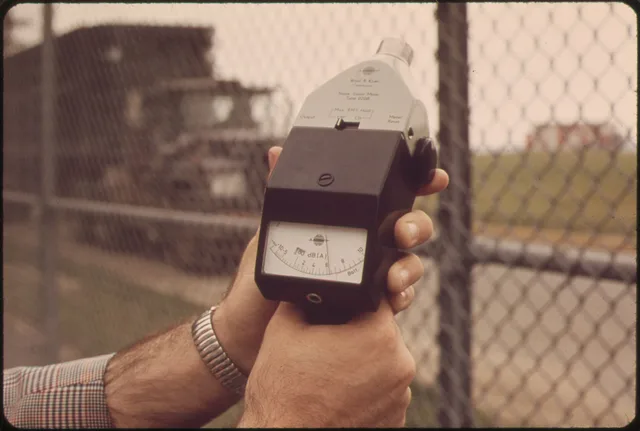
For a comparison in one room, a phone is fine. For anything that has to hold up outside your household, the instrument matters. NIOSH publishes its own sound level meter application, which it describes as accurate to within plus or minus 2 A-weighted decibels, tested in a reverberant chamber at its acoustics laboratory.
With a calibrated external microphone it meets the Type 2 requirements of the IEC 61672:3 sound level meter standard. It reports the metrics professional instruments report, including LAeq and time-weighted average, and offers A, C and Z weighting. NIOSH also states why it is iOS only: Android hardware varies too much between manufacturers for the accuracy to be verified.
Stage four: the conditions
- Same time of day.
- Same doors, windows and ventilation.
- Same equipment running.
- Same typing, at the same pace, for the same duration.
- Microphone in the same position, at the listener's head height.
Any one of these will move a reading further than the change you are testing.
Stage five: the record
Write down level, weighting, position, phone, time, and what was running. Without that context, a reading cannot be repeated. A measurement you cannot repeat is not evidence.
The habit of recording changes this way matches how to test whether a change is working. The underlying sound sources are set out in what makes a keyboard quiet.
Common questions
Do I need a real sound level meter?
What is A-weighting?
Why does my reading jump around?
Can I compare my number to one I read online?
In this guide
- Setting up a desk noise test: what the work involves, explained properlySetting up a desk noise: where to put the microphone, how long to record, and the setup errors that make two readings incomparable. A practical setup you can repeat.
- Is a desk noise test worth paying for, and when does the cost make sense?A free app answers most household questions. What the paid options add, when a measurement is worth buying, and why a shared building changes the answer.
- Desk noise testing: six questions before buyingDesk noise testing buying guide: six questions on app accuracy, external microphones, weighting, and who has to accept the result.
- Does measuring your desk noise actually settle anything, or just waste an evening?Is measuring your desk noise worth the trouble?: measurement helps in a few specific situations and wastes an evening in all the rest. How to tell which one you.
- Noise readings drift over time, so a short recheck keeps them trustworthyKeeping a noise measurement repeatable over time: instruments drift, rooms change and phones get replaced. What to check, what to record, and how to keep a year-old.