Reviews
Part of Desk noise test: five stages, from vocabulary to a repeatable record
Desk noise testing: six questions before buying
Desk noise testing buying guide: six questions on app accuracy, external microphones, weighting, and who has to accept the result.
Before buying anything that measures sound for desk noise testing, answer these six questions. Several of them will send you back to the free option, which is usually the correct outcome.
What to take away
- Most sound measurement apps are not accurate enough for anything official, and a small number are.
- An external calibrated microphone changes the answer more than a different app does.
- Ask who must accept the result before choosing an instrument.
- If the answer will only ever be compared to itself, buy nothing.
Question one: who has to believe this?
If the answer is you and one other person in the house, a phone is enough. If the answer includes a landlord, an employer or an insurer, the instrument needs a calibration record and the method needs to be written down. That single question decides most of the budget.
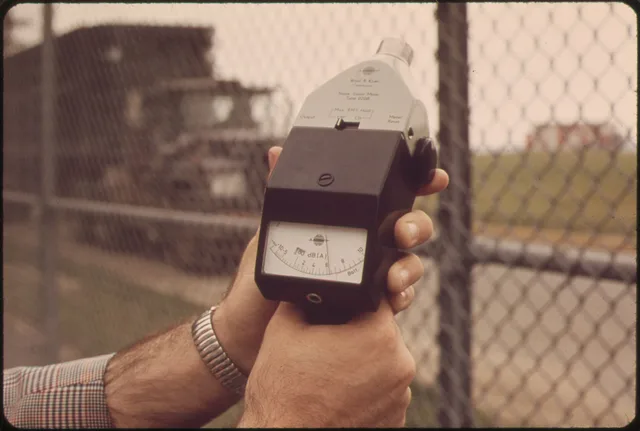
When the answer includes an employer or an insurer, the benchmark is written down. On the workplace side that means OSHA's noise standard for general industry and NIOSH's recommended exposure limit. A meter that anyone else will rely on should state the sound level meter standard it meets, such as IEC 61672 or ANSI S1.4, and its calibration certificate should come from a lab accredited to ISO/IEC 17025.
Question two: has this app been tested against a reference?
Very few have. One study acquired a representative sample of phones and tablets, then screened more than 130 iOS applications and found only ten that met its selection criteria. Only four of 62 Android applications were tested at all.
Apps tested against reference
- 130+iOS apps screened
- 10met selection criteria
- 62Android apps screened
- 4Android apps tested
Of those that were tested, two showed mean differences of 0.07 dB unweighted and minus 0.52 dB A-weighted against the reference system, and two more were within plus or minus 2 dB. The conclusion was narrow and useful: certain apps may be appropriate for occupational measurements, and most are not.
Question three: microphone or app?
If you spend anything, spend it here. A follow-up study re-tested the four best apps with external calibrated microphones rather than the phone's own, and measurements came within plus or minus 1 dB of the reference.
Phone mic vs external mic
Phone's own mic
- Accuracy
- Wider spread
- Limiting factor
- Built-in hardware
- Variability
- High
- Best use
- Rough check
External calibrated mic
- Accuracy
- Within ±1 dB
- Limiting factor
- Calibrated hardware
- Variability
- Removed
- Best use
- Occupational measurement
The authors attribute the improvement to removing the variability and limitations of built-in phone microphones. The hardware in your pocket is the limiting factor, not the software.
Question four: which weighting and which average?
Weighting and average
- A-weighting for anything you intend to compare with published figures.
- C-weighting if the complaint is about low-frequency thud through a structure.
- An equivalent continuous level over a stated period, not a peak.
- The same choices for the before and the after readings.
An app that does not let you set these is an app that cannot be used for a comparison. Most free apps default to A-weighting and a fast response. That is fine for a first look and wrong for anything you intend to repeat, because a fast response reports the peaks and a comparison needs the average.
Question five: can you repeat it in a year?
Instruments drift, phones get replaced, and rooms change. If the measurement is meant to support a decision over time, ask what the calibration path is and what it costs. If there is no answer, treat the instrument as disposable and plan to re-baseline whenever it changes.
Question six: is measurement even the bottleneck?
Often it is not. If nobody disputes that the noise exists, measuring it changes nothing, and the money is better spent on the change itself. The ladder of options and what each rung buys is set out in what desk noise testing costs, and the stages of a full test are in what happens at each stage.