Guides
Part of Top desk sound control products for 2027, reviewed
6 pointers on desk sound control products that hold up
Six checks on desk sound control products, from switch force and case foam to desk mats and stabilizer lube, with the brands worth measuring before you buy.
A quiet desk is a stack of small products, and most of them fail quietly. These six pointers cover desk sound control products worth buying, what to measure, and what to skip. Each one names a part you can look up before you pay.
What to take away
- A sound meter app at a fixed 30 cm from the keyboard, before and after, is the only honest test.
- Switch force and case foam change pitch; desk mats and rubber feet change level. Buy for the problem you have.
- Foam, felt and cork compress. Re-measure at 30, 90 and 180 days, because the reading drifts down.
- Silicone O-rings and gasket mounts are reversible. Adhesive dampening sheets are not.
- Dampening a keyboard does not fix a noisy chair, a hollow desk or a hard floor.
- Parts worth looking up by nameKrytox 205g0 grease, Poron case foam and a Grovemade desk mat. Also Sorbothane hemispheres, Pemko door gaskets and Owens Corning 703 panels.
Pointer 1: measure the keyboard, not the room
Put the phone or meter 30 cm from the spacebar, at the height of your ears when seated. Type the same 40 words twice, once with the current setup and once with the candidate product.
Decibel drop verdicts
- 2 to 4 dBaudible in a quiet room
- Under 1 dBinside your own typing noise
- 30 cmmeasurement distance from spacebar
Write both numbers in a log with the date. A 2 to 4 dB drop is audible in a quiet room. Anything under 1 dB sits inside the noise of your own typing, so it is not worth the money.
Pointer 2: match the product to the noise
Bottom-out clack is a level problem. Top-out rattle is a pitch problem. They need different products.
Match product to noise
Noise
- Bottom-out clack
- Keycap hits plate
- Hollow top-out
- Case resonance
- Dull thud
- Desk surface
- Click on release
- Loose stabiliser wire
Source
- Bottom-out clack
- O-rings or softer plate
- Hollow top-out
- Case foam, gasket mount
- Dull thud
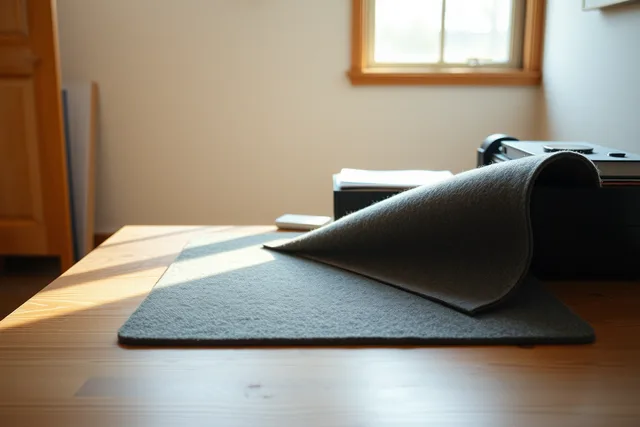
- 4 to 6 mm desk mat
- Click on release
- Dielectric grease on wire
Product
- Bottom-out clack
- Hollow top-out
- Dull thud
- Click on release
Match the product to the noise
| Noise | Likely source | Product that addresses it |
|---|---|---|
| Sharp bottom-out clack | Keycap hitting the plate | Silicone O-rings under caps, or a softer plate |
| Hollow, ringing top-out | Case resonance | Poron case foam, gasket mount, polycarbonate plate |
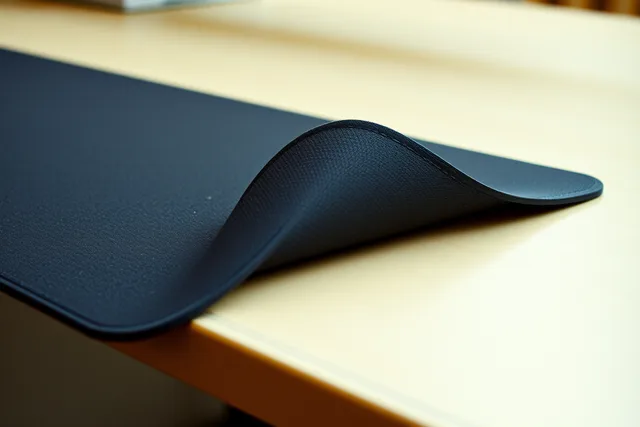
| Dull thud that carries | Desk surface | 4 to 6 mm felt-and-rubber desk mat, Sorbothane or 3M Bumpon feet |
| Click on release | Loose stabilizer wire | Dielectric grease or Krytox 205g0 on the wire, not the housing |
The dielectric grease in that last row is the type sold at auto parts stores, such as Permatex Dielectric Tune-Up Grease. Buy for the row you actually hear. A desk mat will not fix a ringing case, and case foam will not fix a hollow desk.
Pointer 3: name the products worth measuring
Six categories, each with the named part and the spec a seller should publish before you buy.
Six categories to measure
- Switch dampeningsilicone O-rings, 100 to 120 counts
- Case foamclosed-cell polyethylene or EVA sheets
- Desk matsfelt-and-rubber, 3 to 6 mm thick
- Rubber feetSorbothane or nitrile hemispheres
- Door sealsfriction-fit or screw-fixed, sold by metre
- Absorber panelsmineral wool or melamine, published coefficient
Name the products worth measuring
- Switch dampening: silicone O-rings.Sold by keyboard suppliers in 100 to 120 counts, typically a few dollars a bag. They are cheap and reversible, and they change the feel of a key more than the sound. The spec to ask for is durometer.
- Case foam: Poron, closed-cell polyethylene and EVA.Poron is a Rogers Corporation microcellular urethane, and KBDFans sells kits cut to fit specific board models, typically $10 to $25. Plain polyethylene and EVA sheets are sold by the sheet and priced by area, not by keyboard.
- Desk mats: Grovemade and Orbitkey.Both sell two-layer felt-and-rubber mats, typically 3 to 6 mm thick and $80 to $150. The rubber base does the work; the felt is the surface. Grovemade makes its pads in Portland, Oregon.
- Rubber feet: Sorbothane and 3M Bumpon.Sorbothane Inc. sells hemispheres by diameter and durometer, typically $10 to $25 a pack. Nitrile hemispheres are cheaper, sold the same way, and 3M Bumpon bumpers are self-adhesive polyurethane for a few dollars.
- Door seals: Pemko and Zero International.Both publish compression ranges for friction-fit and screw-fixed acoustic seals, sold by the foot or meter. Typical cost is $5 to $20 per foot, and Trademark Soundproofing sells consumer kits.
- Absorber panels: Owens Corning 703, Rockwool Safe'n'Sound and GIK Acoustics 242.Owens Corning 703 is a rigid 3 pcf fiberglass board, typically $10 to $20 per 2-inch panel from insulation suppliers. GIK publishes absorption data for its 242 panel, typically $100 to $150 each. Melamine panels do the same job at a lower price.
For each, ask the seller for the published specification. If there is none, the product is a guess.
Pointer 4: check the rules before the drill
Fixed panels, door replacements and floor build-ups are not yours to install in a rented apartment. Albuquerque's environmental health department publishes sound level limits set by zoning rather than by the actual use of a location, and the ordinance excludes aircraft, earthshaking vibration, emergency repair work and school events.
Ten minutes on your own city's page tells you whether a piece of work needs permission. OSHA's noise in construction page collects the standards behind the source-path-ear hierarchy: engineering controls first, personal protection last.
Pointer 5: order the steps by reversibility
Loose items first, fitted items second, structural work last. Each step changes what the next one needs to do.
Order by reversibility
- Desk mat, rubber feet, felt pads
- Case foam, O-rings, stabiliser grease
- Door seal, heavy curtain, shelving
- Wall panels, floor build-up, door replacement
Steps one and two take an afternoon: a Grovemade mat, Sorbothane feet and a foam kit cover most of it. Most desks never need steps three or four.
Pointer 6: re-measure as the products age
Foam, felt and cork compress. Door seals lose compression. Mats take a set where your chair rolls.
Re-run the 30 cm test at 30, 90 and 180 days, and write each number down. A product that lost 3 dB in three months was the wrong product, not a bad install.
The full workspace sequence is in what installation really involves. Category-by-category test results are in what each type actually does.
Common questions
Do I need to tell my landlord about a door seal?
If it is friction fit or fixed to the door leaf, usually not. If it involves the frame, ask. Your lease and local tenancy rules decide, not this article.
Which product gives the biggest drop for the money?
A 4 to 6 mm desk mat and rubber feet, in that order. They are the cheapest reversible steps, and they address the surface that amplifies everything else. A generic felt-and-rubber mat costs less than the Grovemade pads, and 3M Bumpon feet cost less than Sorbothane hemispheres.
Can I install absorbers without drilling?
Often, using freestanding frames or picture rails. Owens Corning 703 boards fit most freestanding frames. Adhesive on painted walls is what causes deposit disputes, and it is not reversible.
How long between steps?
A full working day, including the activity that caused the complaint. Faster than that and you are guessing which product worked.