Reviews
Part of Top desk sound control products for 2027, reviewed
Sound control gear: what to check on frequency, distance, and failure before buying
Questions to ask before buying desk sound control products: which category, which frequencies, which distance, and what happens if it fails. The questions that stop.
These questions apply to anything sold for controlling desk sound: mats, panels, screens, maskers, headsets. Most of them can be answered before you leave the seller's page.
What to take away
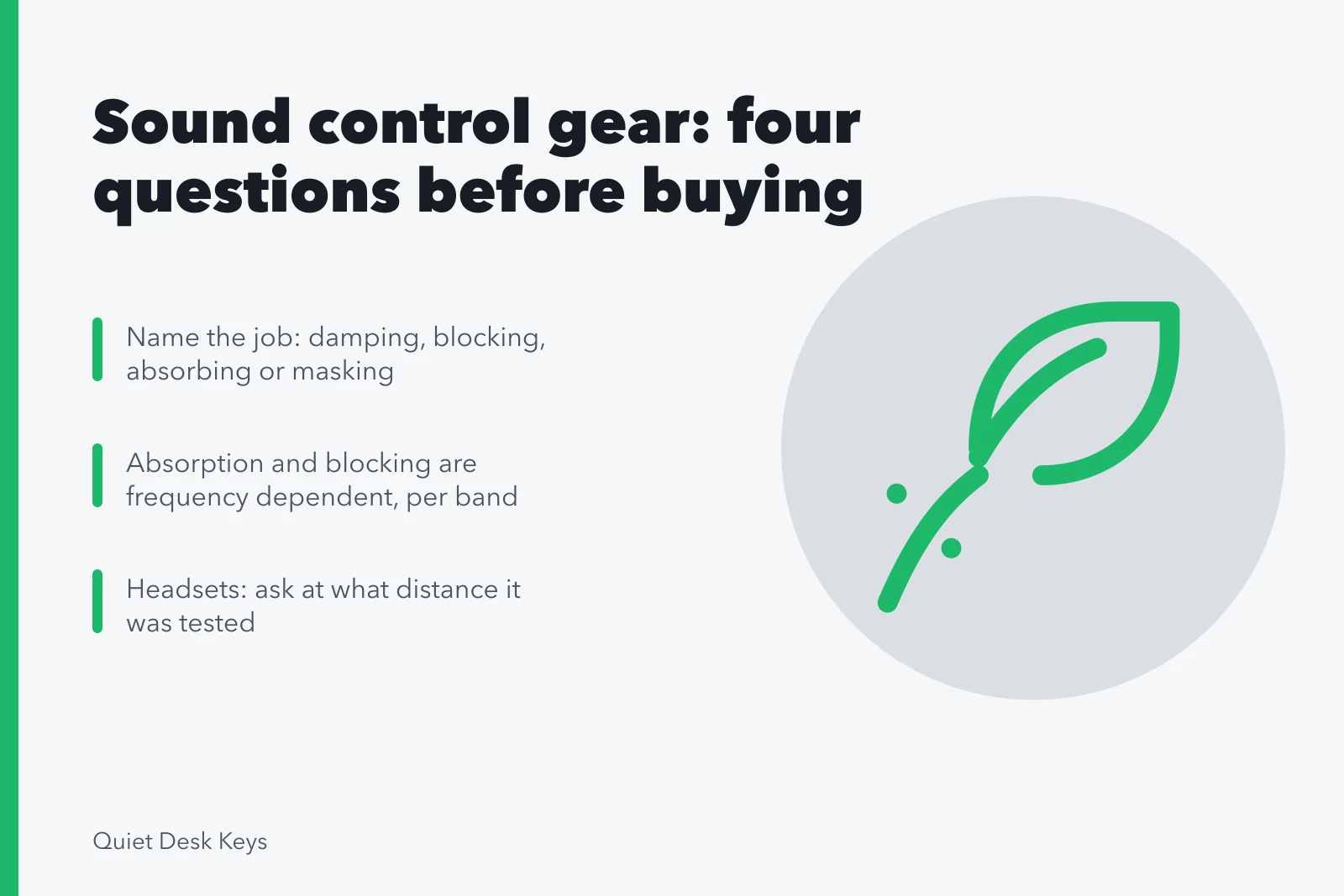
- Ask which of the four jobs it does. A seller who cannot say is selling absorption by default.
- Ask about frequencies, because performance is never flat across the range.
- With headsets, distance to the source changes everything, and marketing rarely states it.
- Agree in advance what failure looks like, or you will keep the thing regardless.
Question one: which job, and which path?
Damping, blocking, absorbing or masking. Then: does the sound reach the listener through the air, through the structure, or through a microphone? A product that addresses a different path from the one you have will do nothing at all, however good it is.
Match product to sound path
Which job: damping, blocking, absorbing, masking?
Path: air, structure, or microphone?
Yes -> product addresses your path
Question two: what happens at each frequency?
Absorption and blocking are both frequency dependent, and published data, when it exists, is given per frequency band. If a product publishes one number with no frequency, treat it as a headline rather than a specification. This is also why a room can measure the same before and after and sound noticeably different.
Frequency data: spec vs headline
Per-band data
- What it is
- Specification
- Frequency shown
- Each band
- Use for buying
- Compare
- Room result
- Predictable
Single number
- What it is
- Headline
- Frequency shown
- None
- Use for buying
- Ignore
- Room result
- Same reading, different sound
Question three: for headsets, at what distance was it tested?
Active noise control performance depends on the source and its distance. A study of active noise control devices in dental treatment conditions tested two commercial headsets and two dental headsets against three noise sources.
Measurements were taken at 10, 40 and 70 centimeters to represent the positions of the patient, assistant and practitioner. Distance was a deliberate variable.
At a desk the equivalent question is whether the thing bothering you is your own keyboard at 30 centimeters or a conversation at four meters. A headset performs very differently against those two.
Question four: what is being assessed, exactly?
Sound comfort is not one quantity, and researchers are still building the instruments to measure it properly. A recent study developing a structured questionnaire for open-plan offices ran expert focus groups to identify the acoustic and non-acoustic factors a soundscape assessment needs to capture.
Its premise: existing methods do not capture the complexity of these environments. If specialists need a multi-factor questionnaire, a product claim reducible to one word is not describing your experience.
Question five: how will you know it failed?
How will you know it failed?
- What specific complaint should change, and who reports it?
- By when?
- What is the return window, and does it cover an opened item?
- What will you do with it if it does not work?
Question six: what does it need from the room?
Coverage area, mounting, power, airflow matter: absorbers need surface area for measurable effect, while maskers need distribution, not one loud speaker in a corner. Screens must be tall and close enough to break the line between two people.
Anything powered needs a reachable socket and a supply that does not hum, a real failure mode for cheap maskers. Anything mounted needs permission if you rent, plus a plan for the holes when you move out.
Once these are answered, the category map in what each type actually does narrows the field quickly, and the physical sequence is in installation steps.