Reviews
Part of Keyboard brands in 2027: four checks that need no company name
Keyboard brand spec sheets compared: separating measured facts from marketing words in 2027
Keyboard spec sheets mix measured numbers with marketing adjectives. Reading them side by side separates what a brand tested from what it only claims.
A product page is two documents stapled together. One holds measurements you can compare. The other holds adjectives you cannot. Put four brands side by side and the split becomes obvious.
What to take away
- Compare only numbers that carry a unit and a stated test condition.
- Terms with no agreed definition are marketing, however technical they sound.
- Public guidance names its sources. Product pages almost never do, and that gap tells you something.
- Count the blanks in each column before you compare the numbers.
- A missing figure is an answer, not an invitation to guess.
Four sheets, read the same way
Keychron publishes switch type, travel, actuation force, case material and weight for each board. Its Q and V series list gasket mount and hot-swap sockets, so those claims are checkable against the board in your hand.
What each brand publishes
Keychron
- Switch type
- yes
- Travel / actuation
- travel
- Case material
- yes
- Keycap material
- no
- Polling rate
- no
- Battery hours
- no
Wooting
- Switch type
- analog
- Travel / actuation
- mm points
- Case material
- no
- Keycap material
- no
- Polling rate
- yes
- Battery hours
- no
Ducky
- Switch type
- yes
- Travel / actuation
- no
- Case material
- yes
- Keycap material
- yes
- Polling rate
- no
- Battery hours
- no
Logitech
- Switch type
- yes
- Travel / actuation
- no
- Case material
- no
- Keycap material
- no
- Polling rate
- no
- Battery hours
- yes
Wooting publishes analog travel range and actuation points in millimeters, plus polling rate. Those are the numbers a competitive player actually selects on.
Ducky lists switch, layout, keycap material and profile, and case material. Less depth than Keychron, but the same categories, which makes it comparable.
Logitech's MX Mechanical lists battery life in hours with backlighting on and off. That is a measured figure with a condition attached, which is the standard the rest of the page should meet.
Where the adjectives live
Keychron calls a board "fully customizable." Wooting calls a switch "rapid trigger." Ducky leans on "premium." Logitech says "quiet."
None of those words has a unit. Rapid trigger is a feature name, not a measurement, and the travel figure beside it is the part you compare.
The FTC's green guides exist because what a company means by a claim and what a buyer hears can differ. They cover environmental claims, but the pattern holds for "quiet" and "ergonomic" too.
What sourced guidance looks like
The OSHA computer workstation eTool closes with an annotated reference list naming the documents behind its advice. One is a NIOSH publication on alternative keyboards that asks whether those designs prevent injury at all.
That is a source you can pull and read. A product page claiming health benefits with no citation is not doing the same thing.
Ask what document would have to exist for a claim to be true, then look for it. Usually it does not exist.
Build the sheet
- One row per candidate, one column per measured fact.
- Add a column counting the facts you had to leave blank.
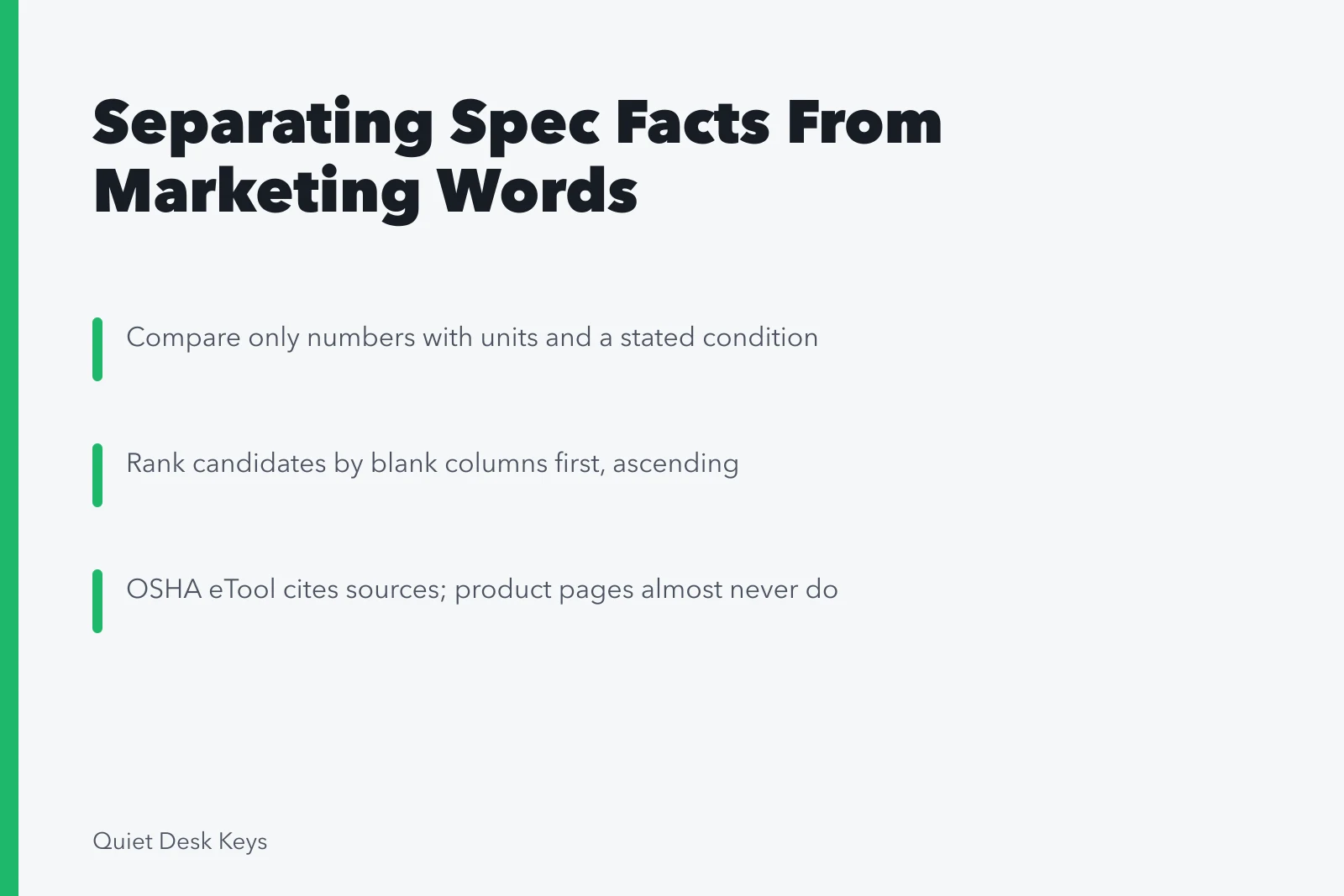
- Rank by blanks first, ascending.
- Compare numbers only among rows with the same blank count.
- Ignore every adjective in the source material.
The blanks step is the one people skip. A board with four blanks is not comparable to one with none, whatever its numbers say.
Build the comparison sheet
- One row per candidate, one column per fact
- Add a column counting blank facts
- Rank by blanks first, ascending
- Compare numbers only at equal blank count
- Ignore every adjective in the source
Before you buy
Shortlist from the sheet, then test in place inside the return window. No column count changes how a switch feels under your fingers.
The maker-level checks come first: judging a keyboard maker. Then read what owners actually report in what claims and reviews each leave out.
Common questions
Is ergonomic a meaningful word on a product page?
Not alone. Ask which posture the design supports and at what height, and the answer becomes checkable. If the brand cannot say, treat it as a blank.
What if two brands list the same number differently?
Then they are not comparable until you find the measurement condition. Ask the brand, and treat no answer as a blank.
Should I trust an in-house test?
Only with a published method. An in-house test with a stated method beats an independent one without. Where a figure matters and no method is published, the manufacturer's own specification sheet is the only verifiable source.
How many boards belong on the sheet?
Three to five. Past that the blanks stop being visible, which defeats the exercise.