Maintenance
Part of Real published field research beats an invented workspace case study
Which workspace lessons fail to transfer to your own desk?
Lifting a number out of a study is the most common error. What transfers between settings, what does not, and how to tell the difference quickly.
Research is useful and it is easy to misuse. The errors below are the ones that turn a good study into a bad decision, and each has a quick test that catches it.
What to take away
- Numbers do not transfer between buildings. Methods do.
- A finding from a different climate, culture or building type is a hypothesis for you, not a result.
- Prior experience changes outcomes, which is why two people report differently from the same change.
- Read the limitations section. It is short and it is where the authors tell you what not to do with their work.
Mistake one: lifting the number
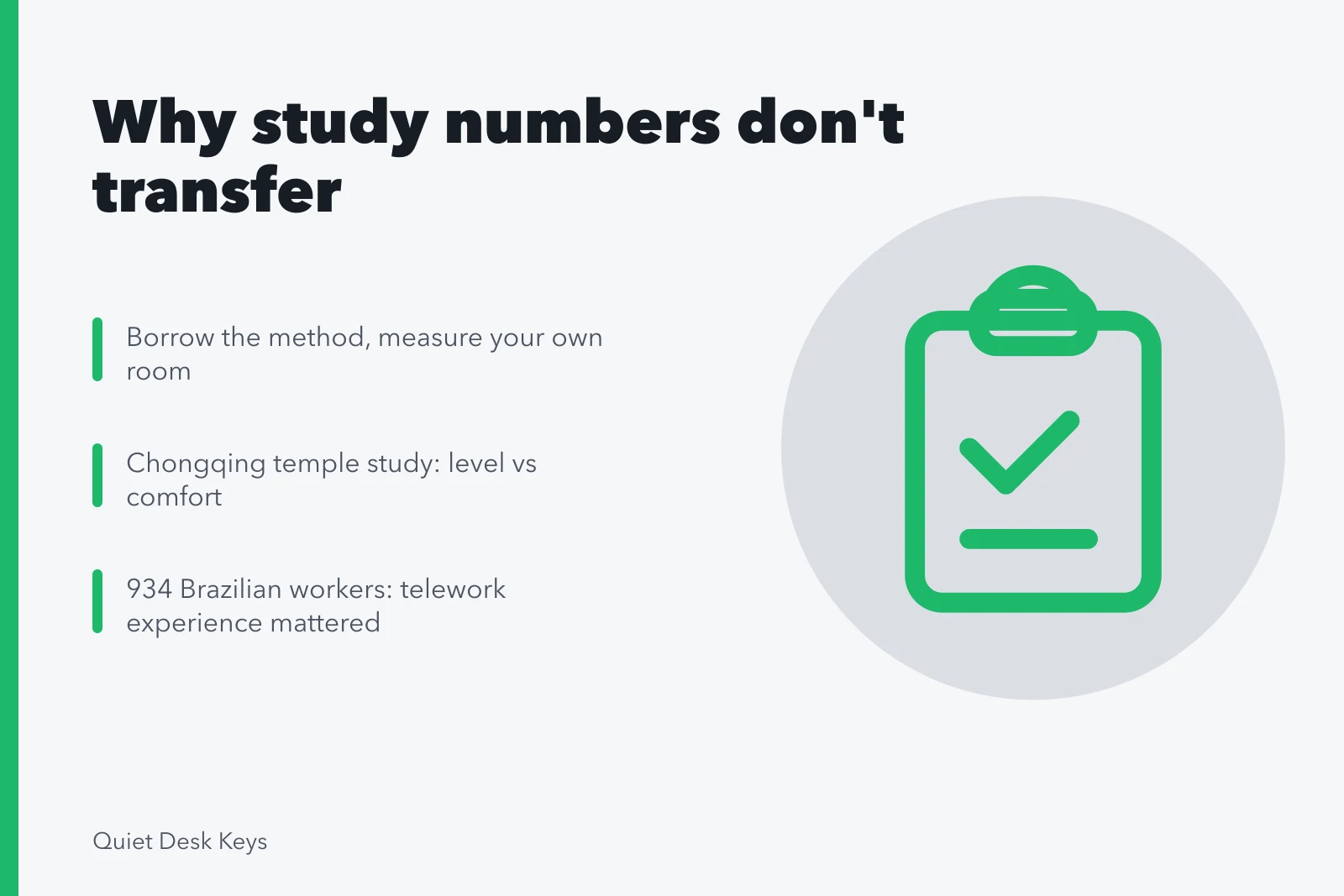
A measured level in someone else's office describes their room, their instrument and their day. Borrow the approach and measure your own. This is the single most common error and the easiest to avoid.
Mistake two: ignoring the setting
A soundscape study at a Taoist temple in Chongqing used field measurements, interviews, soundwalks and audio-visual experiments. It found a significant negative relationship between the measured five minute equivalent level and reported soundscape comfort, plus effects from what people could see.
The general link between level and comfort travels, but the specific values and visual context belong to that site.
Mistake three: forgetting that experience changes the outcome
A cross-sectional study of 934 workers in the Brazilian labor judiciary during the pandemic found that previous experience of teleworking was associated with a better evaluation of the home workstation. It found a smaller workload increase.
Two people can make the same change to the same room and report different results because prior familiarity is one of the strongest moderators.
Mistake four: treating a positive finding as a recommendation
Most studies report an association under stated conditions, but not advice to buy; marketing lives in that gap.
A finding that people in treated rooms reported less annoyance is not an instruction to buy panels. It says nothing about how much treatment, at what cost, or whether the same people would report the same after any visible room change.
Mistake five: skipping the limitations
| What you read | What to check |
|---|---|
| A large effect | Sample size and whether it was randomised |
| A precise number | The measurement conditions |
| A confident conclusion | Whether the authors hedge it in the limitations |
| A single site | Whether anyone has replicated it |
A quick test before borrowing anything
Ask three questions: Is the building like mine, are the people like me, and was the thing measured the thing I care about? If any answer is no, take the method and drop the number.
Borrow Method Or Number?
Is the building like mine?
keep going
take the method, drop the number
General process errors alongside it are in the mistakes that waste the most time. The case for reading research at all is in published field studies worth reading.