Reviews
Top desk sound control products for 2027, reviewed
No products are reviewed here. The four categories of desk sound control, the physics each one relies on, and which complaint each one can honestly address.
No desk sound control product here was bought or tested by this site. Verdicts below come from published specifications and independent lab or field data, and prices are typical US retail as of early 2026.
What to take away
- Four categoriesdamping, blocking, absorbing and masking. They are not interchangeable.
- Damping matters most at a desk and is the least often sold as a product.
- Masking works, and real offices run it below the level of normal speech.
- The ear is not equally sensitive across frequencies, so a treatment can change the feel more than the number.
- Named products below include Sorbothane, IsoAcoustics, GIK Acoustics, Biamp Qt and LectroFan.
The four categories
What it does
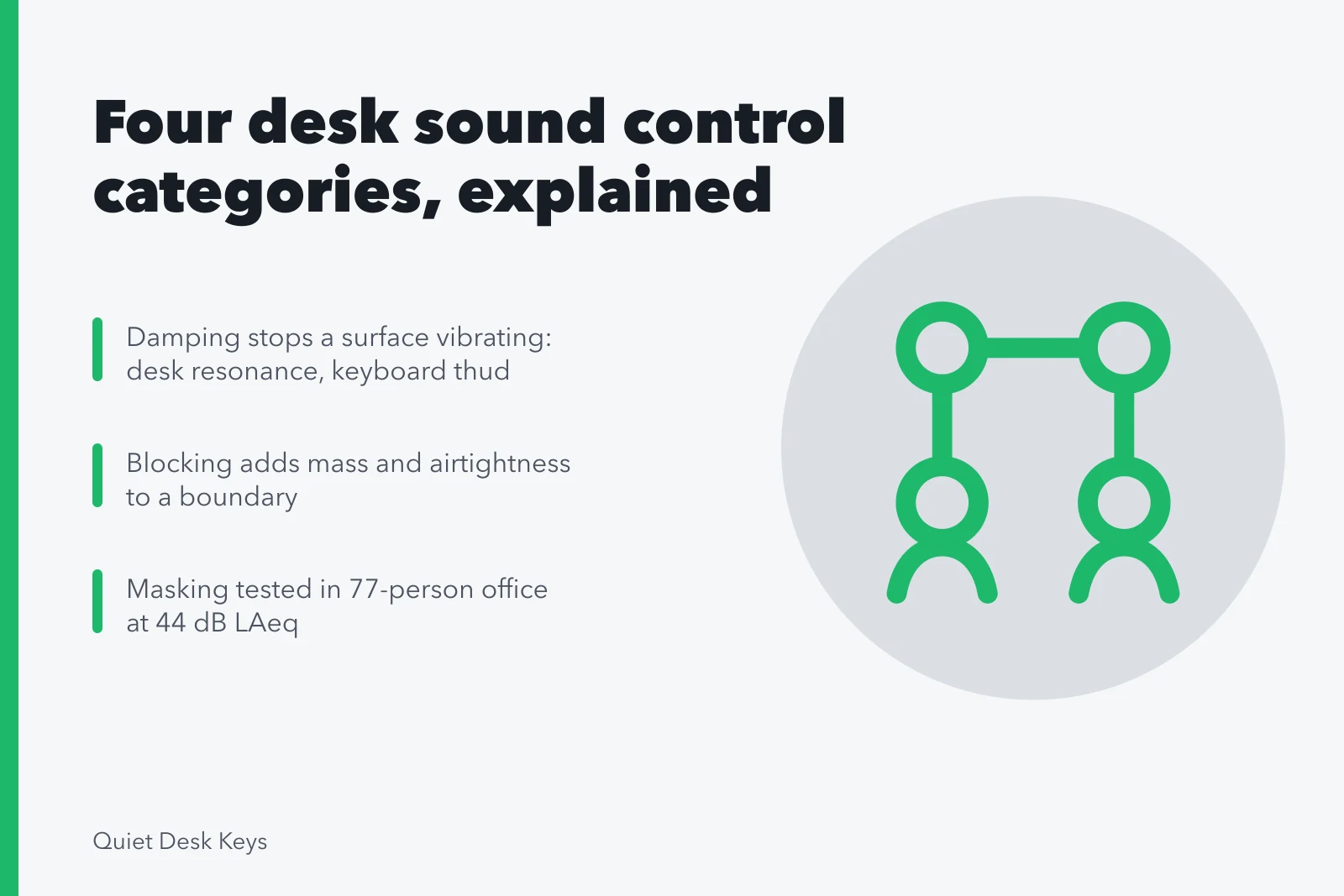
- Damping
- Stops a surface vibrating
- Blocking
- Adds mass and airtightness to a boundary
- Absorbing
- Reduces reflections inside a room
- Masking
- Adds sound to reduce speech intelligibility
Right for
- Damping
- Desk resonance, keyboard thud, chair rumble
- Blocking
- Sound reaching another room
- Absorbing
- A room that sounds harsh to you
- Masking
- Overheard conversation in shared space
Most desk complaints are damping problems treated as absorbing problems. That is why so many people end up with wall panels and an unchanged complaint. The products below sit in the category that serves the complaint.
Four categories of desk sound control
Damping
- What it does
- Stops surface vibrating
- Right for
- Desk resonance, keyboard thud
- Physics
- Vibration control
Blocking
- What it does
- Adds mass, airtightness
- Right for
- Sound reaching another room
- Physics
- Mass and seal
Absorbing
- What it does
- Reduces room reflections
- Right for
- Room sounds harsh to you
- Physics
- Reflection reduction
Masking
- What it does
- Adds sound to mask speech
- Right for
- Overheard conversation
- Physics
- Speech intelligibility reduction
Damping: products that stop the desk from vibrating
Damping is the cheapest category and the hardest to buy, because few sellers label it that way.
Damping products
- Sorbothane pads and hemispheres (Sorbothane Inc., Kent, Ohio). Sheets, discs and feet in several durometers, typically $20 to $50. The material needs load, so it suits a keyboard tray or a monitor stand.
- IsoAcoustics ISO-PUCK mini (IsoAcoustics, Ontario). A four-pack runs typically $60 to $120. It decouples studio monitors and publishes isolation curves.
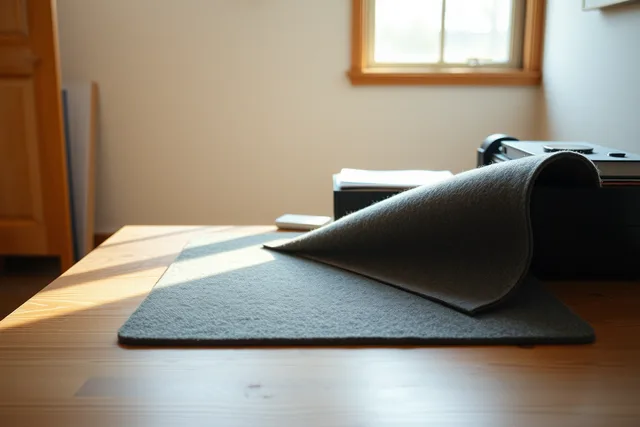
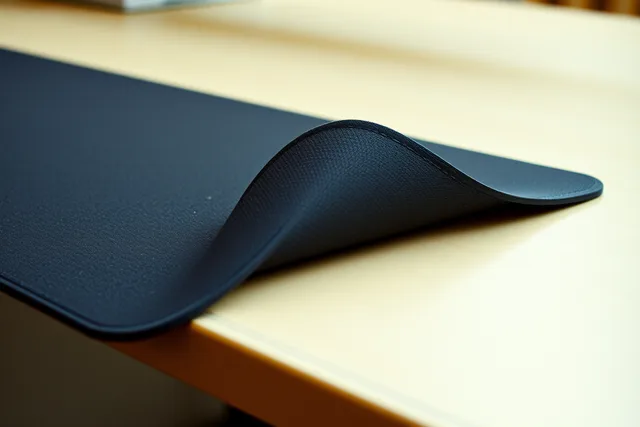
- Grovemade wool felt desk pad (Grovemade, Portland, Oregon). Merino felt, typically $100 to $200 by size. It removes the keyboard clack that sets the desktop ringing.
Verdict: Sorbothane for thud and rumble, a felt pad for keyboard noise.
Blocking: mass and airtightness at the boundary
The door is usually the largest leak.
Blocking products
- Trademark Soundproofing door seal kit. Perimeter gasket and automatic bottom sweep, typically $75 to $200 per door. It needs trimming to fit, and it attacks the largest leak first.
- MD Building Products door sweep. A 36-inch aluminum and vinyl sweep, usually under $20 at a hardware store. The cheapest fix for a gap under a door.
- Green Glue Noiseproofing Compound (Saint-Gobain). A viscoelastic compound for walls and ceilings, typically $25 to $50 per 28-ounce tube, two tubes per 4-by-8-foot sheet.
Verdict: seal the door before buying anything else.
Absorbing: taming a room that sounds harsh
Absorbers change how a room sounds to the people inside it. They do not stop sound leaving the room.
Absorbing products
- Owens Corning 703 fiberglass board, 2 inch, 3 lb density. Typically $15 to $30 per 2-by-4-foot panel from acoustic retailers such as ATS Acoustics. It needs a frame and fabric wrap.
- GIK Acoustics 242 panel (GIK Acoustics, Atlanta, Georgia). A 2-by-4-foot, 2-inch fabric-wrapped absorber, typically $100 to $130 each. It hangs out of the box.
- Auralex Studiofoam Wedge, 2 inch, 24-pack. Typically $120 to $180 for 24 square feet. Thin foam works on high frequencies, which is the job most buyers want it for.
Verdict: two 2-inch panels at the first reflection points beat a wall of 1-inch foam.
Masking: the category with field evidence
Masking has the best field evidence, and the levels involved are modest. One long-term experiment ran in an open-plan office of 77 employees already accustomed to artificial masking.
Researchers compared water-based masking sounds against the pseudo-random masking sound the office already ran at 44 dB LAeq, to see how the occupants perceived each condition.
Masking level in a real office
44 dB LAeq
Open-plan office of 77 employees
Water-based masking vs pseudo-random masking
Runs well below normal speech level
So masking in a working office runs well below the level of normal speech. The character of the sound is a design decision, not a detail.
Masking products
- Biamp Qt Quiet Technology (formerly Cambridge Sound Management). Emitters plus a Qt 300 or Qt 600 controller, dealer installed, typically $1,000 to $3,000 for hardware in a small office. It is the product class the research above measured.
- LectroFan Classic (Adaptive Sound Technologies). About $50, with ten fan sounds, ten noise colors and variable volume.
- Yogasleep Dohm (Yogasleep, formerly Marpac). About $50, a mechanical fan with adjustable tone and volume.
- MyNoise.net. A browser masking generator with per-band sliders, free with donation-supported extras.
Verdict: buy the adjustable one, and set it lower than feels right at first.
Why frequency matters as much as level
Treatments do not act evenly across the spectrum, and neither does hearing. Georgia State University's physics reference on the sensitivity of the human ear puts the audible range at roughly 20 Hz to 20 kHz.
The ear detects pressure variations smaller than one billionth of atmospheric pressure. Its wide dynamic range depends partly on protective mechanisms that reduce the response to very loud sounds.
At a desk, a thin absorber that removes high frequencies can calm a room while barely moving a broadband measurement. A low-frequency thud can be quiet on a meter and impossible to ignore.
What to buy first
- Sorbothane pads or a felt desk pad under the keyboard and under the monitor stand. This is damping, the cheapest category.
- A Trademark or MD door seal, if the complaint is in another room. This is blocking, done at the largest leak.
- Soft furnishing before panels, if the room sounds harsh to you. A rug costs less than a wall of GIK 242s.
- Masking last, and only if the problem is overheard speech. A LectroFan or MyNoise costs about $50 or less.
The catalog of specific ideas in each category is in ideas sorted by what they fix. The pre-spend questions are in a pre-purchase check.