Reviews
Part of Which silent switch type makes sense for which typist, in plain terms
Silent keyboard switches: the parts worth your attention
Silent keyboard switches: damped stems, aftermarket pads, lubricant and different springs all reduce switch noise differently. What each one changes.
This compares approaches, not whole keyboards. Four changes make a silent keyboard switch quieter, each working on a different part of the mechanism, and they can be combined. Knowing which one addresses which noise is the whole job, and the silent keyboard switches, lubricants, pads and mods named below are the ones people reach for most.
What to take away
- Factory damped stems, aftermarket pads, lubricant and spring changes attack different noises.
- Only the first two touch the impact sounds, which are what other people hear.
- Every option trades away some feel. Decide which feel you are willing to lose.
- Stabilizers are the loudest thing on most boards; dielectric grease, the band-aid mod and the Holee mod are the fixes to try.
The four approaches
Noise it reduces
- Factory silenced stem
- Bottom-out and return impact
- Aftermarket pads or o-rings
- Bottom-out only
- Lubricant
- Spring noise and scratch
- Different spring
- Encourages lighter pressing
Feel cost
- Factory silenced stem
- Mushier end of travel
- Aftermarket pads or o-rings
- Shorter travel, harder stop
- Lubricant
- Slightly slower return
- Different spring
- Different typing effort
Reversible
- Factory silenced stem
- No, it is the switch
- Aftermarket pads or o-rings
- Yes
- Lubricant
- Mostly
- Different spring
- Yes
The table is the article. Everything below is about choosing a row.
Four ways to quiet a switch
Factory silenced stem
- Noise reduced
- Bottom-out and return
- Feel cost
- Mushier end of travel
- Reversible
- No, it is the switch
Aftermarket pads
- Noise reduced
- Bottom-out only
- Feel cost
- Shorter travel, hard stop
- Reversible
- Yes
Lubricant
- Noise reduced
- Spring noise, scratch
- Feel cost
- Slightly slower return
- Reversible
- Mostly
Different spring
- Noise reduced
- Lighter pressing
- Feel cost
- Different typing effort
- Reversible
- Yes
Factory silenced stems
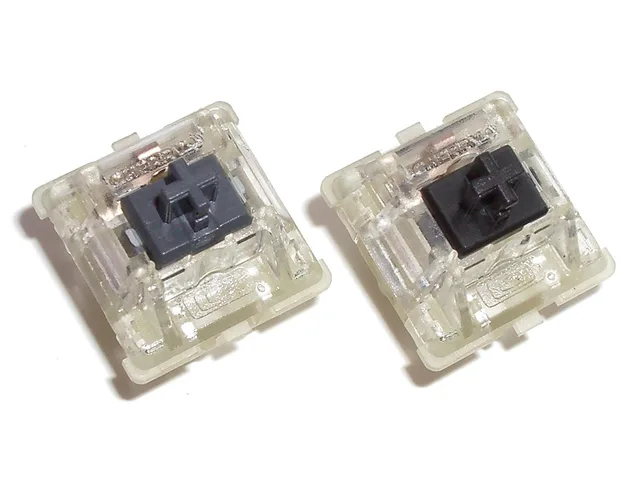
Factory silenced switches build the dampening into the stem: silicone or rubber pads molded into the slider. Cherry MX Silent Red is the reference point, Gateron Silent and Kailh Box Silent follow the same recipe, and Gazzew Boba U4 and Zeal Zilent V2 bring it to tactile switches.
The pads sit inside the switch, so both ends of the travel are damped and every key behaves the same. That consistency is the main advantage over aftermarket fixes. The cost is a softer, less defined stop, which some typists read as vague. If you type hard, this is the option that changes the most.
Aftermarket pads
Cheap, reversible, and only half a solution: they damp the downstroke and do nothing on the return. The two families are soft silicone o-rings that slip over the keycap stem and QMX silencing clips that sit between the switch and the keycap. They also shorten travel, which matters more than people expect. If you already dislike a short board, adding pads moves you further in a direction the evidence does not favor.
Lubricant
The quiet improvement nobody hears from across the room. It removes spring ping and the scratchy edge of the stroke, which makes the board pleasanter for you and barely changes what a neighbor hears. Krytox 205g0 and Tribosys 3203 or 3204 are the lubricants that come up most, all PTFE greases, with the thinner ones the usual choice for tactile switches. Worth doing, wrong to expect it to solve a complaint.
Springs, and why one weight does not fit everyone
Spring weight is where people copy a recommendation from someone with different hands. The spring is what throws the stem back up, so its weight sets how hard the top-out hits the housing: lighter springs mean a softer return, and a different feel under your fingers.
Hands differ, and that is measurable. A laboratory study put fifteen men and fifteen women at a height-adjustable workstation set to each person's own measurements and found, across five standard computer tasks, differences by gender in upper extremity postures, applied forces and muscle activity. A spring weight that feels balanced for one person can mean measurably more effort for another at the same adjusted desk.
Variation beats optimization
No single setting is right all day, and the same is true of a switch. How hard you hit the keys changes what the room hears more than the parts list does, so the same silenced stem can be quiet under one typist and loud under the next.
That is the argument against tuning a board for one position or one style. A setup you can use in more than one way, and adjust when you notice the noise, beats a single perfect setting.
Combining approaches
Silenced stems plus lubricant plus serviced stabilizers is the combination that actually changes what a room hears. Pads alone rarely do. For which family to start from, see which silent switch type makes sense, and for how to read what other people report, see what owner reports can tell you.
Stabilizers, the loudest part of most boards
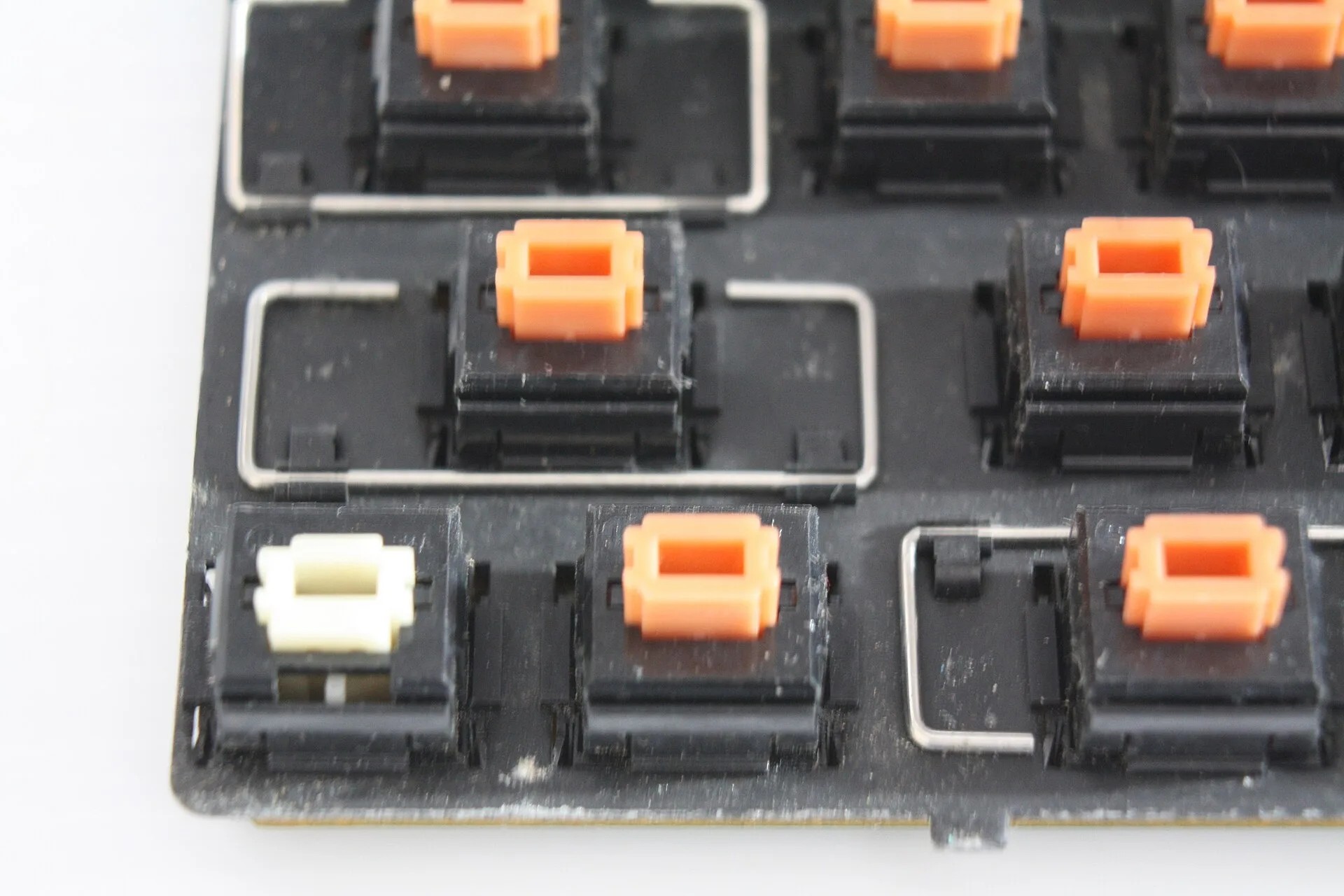
The four approaches above work on the switch, but the rattle most people actually hear comes from the stabilizers under the space bar, Enter and the shift keys, and no damped stem touches it. Greasing the wire ends with dielectric grease is the first and cheapest step.
Beyond that, two known mods do the work: the band-aid mod, a strip of tape where the stabilizer housing meets the board, and the Holee mod, a strip of bandage wrapped inside the stabilizer stem so the wire cannot tick against it.